Air Raid Offense Playbook PDF: A Comprehensive Plan

Discover a detailed, downloadable PDF playbook focusing on the Air Raid offense, encompassing practice schedules and drills from coaches like Hal Mumme and Mike Leach.
Master passing concepts, formations, and routes to elevate your team’s offensive capabilities.
The Air Raid offense, a revolutionary approach to football, prioritizes spreading the field, utilizing a high-volume passing attack, and creating advantageous matchups. This playbook PDF serves as a comprehensive guide to understanding and implementing this dynamic system. Rooted in the philosophies of coaches Hal Mumme and Mike Leach, the Air Raid aims to relentlessly attack defenses through precise route combinations and quick decision-making by the quarterback.
Central to the Air Raid is the emphasis on simplicity for the players, allowing them to react and play fast. The system isn’t about complex play calls, but rather a core set of concepts executed with precision and repetition. This playbook details those core concepts, providing a foundation for building a potent offensive attack. It’s designed for coaches seeking to modernize their offense and unlock its full potential.
Within these pages, you’ll find detailed breakdowns of formations, route trees, quarterback progressions, and practice drills. The goal is to equip you with the knowledge and tools necessary to install and refine the Air Raid offense at any level of play. This isn’t just a collection of plays; it’s a philosophy, a system, and a pathway to offensive success. Prepare to transform your team’s offensive approach!
II. Historical Context & Key Figures
The Air Raid offense didn’t emerge overnight; it’s a product of decades of offensive evolution, with key figures shaping its development. Its origins can be traced back to the innovative coaching of Sid Gillman and his emphasis on the passing game in the 1950s and 60s. However, the modern Air Raid truly took form under the guidance of Hal Mumme at Iowa Wesleyan and later Kentucky.
Mumme, alongside offensive coordinator Mike Leach, refined the system, stripping away complexities and focusing on spreading the field with four and five-receiver sets. Leach then took the Air Raid to Texas Tech, where he achieved remarkable success, establishing the offense as a national force. These coaches weren’t simply drawing up plays; they were challenging conventional football wisdom.
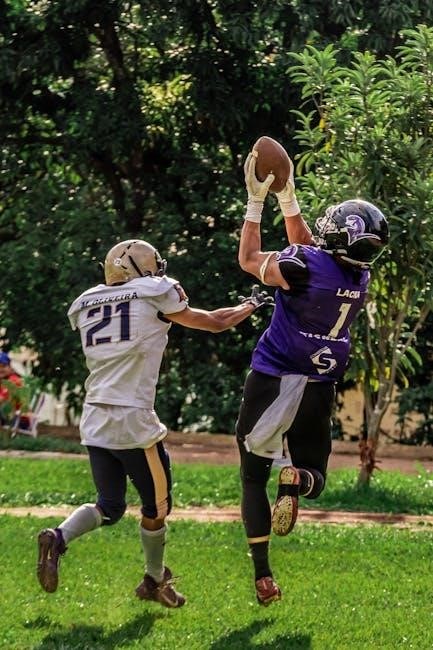
This playbook PDF acknowledges the contributions of these pioneers, providing context for the concepts within. Understanding the historical roots of the Air Raid is crucial for appreciating its underlying principles. It’s a story of innovation, adaptation, and a relentless pursuit of offensive efficiency. The influence of Mumme and Leach continues to resonate throughout college and professional football today, making this a truly significant offensive system.
III; Core Principles of the Air Raid System
At its heart, the Air Raid offense revolves around a few core principles, meticulously detailed within this playbook PDF. First, spreading the field is paramount. Utilizing four or five receivers forces defenses to cover more ground, creating one-on-one matchups. Second, a quick passing game emphasizes short, accurate throws, minimizing risk and maximizing yards after catch.
Simplicity is key. The Air Raid isn’t about complex play calls; it’s about mastering a limited number of core concepts and executing them flawlessly. This playbook focuses on these foundational elements, providing a clear and concise understanding of the system. Tempo also plays a vital role, wearing down defenses and preventing them from substituting effectively.
Quarterback decision-making is crucial. The QB must be able to quickly read defenses and make accurate throws under pressure. This PDF will outline progression reads and techniques for efficient quarterback play. Finally, the Air Raid prioritizes receiver skill development, focusing on route running, catching, and creating separation. Mastering these principles is the foundation for success with this offensive system.
IV. Formations in the Air Raid Offense
This playbook PDF details the diverse formations utilized within the Air Raid system, though variations exist. The foundation often begins with shotgun formations, providing the quarterback with optimal visibility and time to survey the field. Common alignments include 2×2 sets (two receivers to each side) and 3×1 sets (three receivers to one side, one to the other), creating different matchup opportunities.

Empty formations, featuring five receivers and no running back in the backfield, are frequently employed to stretch the defense horizontally. Trips formations, with three receivers clustered on one side, create overload situations and force defensive adjustments. The playbook will illustrate how each formation impacts route combinations and quarterback reads.

Understanding formation flexibility is crucial. The Air Raid isn’t rigid; coaches often adjust formations based on opponent weaknesses and game situations. This PDF provides a comprehensive overview of these formations, including diagrams and explanations of their strategic advantages. Motion and shifting are also integral, adding another layer of complexity and creating confusion for the defense.
V. Passing Concepts: Foundations
This Air Raid offense playbook PDF emphasizes a core set of passing concepts designed to attack all levels of the field. The foundation rests on high-low reads, forcing defenders to choose between covering the short, quick routes or the deeper, more explosive plays. Four verticals is a staple, stretching the defense vertically and creating one-on-one matchups.
Mesh concepts involve crossing routes designed to create natural rubs and confusion for defenders, opening up passing lanes. Y-Cross utilizes a tight end or slot receiver crossing the field, providing a reliable target. The playbook details the progression reads for each concept, guiding the quarterback through his decision-making process.
Spacing concepts aim to create open space for receivers, allowing the quarterback to deliver quick, accurate passes. Screens – both running back and receiver screens – provide quick-hitting plays to counter aggressive pass rushes. Mastering these foundational concepts is paramount to success in the Air Raid, and this PDF provides detailed breakdowns of each, including coaching points and adjustments.
VI. Route Combinations: Detailed Breakdown
This Air Raid offense playbook PDF provides an exhaustive breakdown of route combinations, moving beyond basic concepts. “Shallow Cross” pairs a shallow crossing route with a deep post, stressing the safety coverage. “Double Slant-Flat” creates a quick-read opportunity against man coverage, utilizing two slant routes and a flat route.
“Levels” combines short, intermediate, and deep routes, attacking all zones of the field. The playbook details precise route depths, timing, and receiver responsibilities for each combination. “Spot” routes allow receivers to find open spaces based on defensive alignment, requiring excellent route-running and quarterback-receiver chemistry.
Specific attention is given to route adjustments based on pre-snap reads and post-snap reactions. The PDF includes diagrams illustrating route trees and variations, offering flexibility in game planning. Emphasis is placed on creating advantageous matchups and exploiting defensive weaknesses through strategic route design. Understanding these combinations is crucial for maximizing the Air Raid’s passing attack.
VII. Progression Reads for Quarterbacks
This Air Raid offense playbook PDF dedicates significant attention to quarterback progression reads, the cornerstone of the system’s success. The core principle revolves around a layered approach, starting with the most favorable, high-percentage throw. The first read typically targets the quickest, most open receiver, often on a short or intermediate route.
If the first read is covered, the quarterback systematically progresses to subsequent options, adhering to a pre-determined sequence. The playbook emphasizes “reading the coverage” – identifying defensive alignments and anticipating coverage rotations. Key indicators, such as safety depth and linebacker positioning, guide the quarterback’s decision-making process.
The PDF details specific progression routes for various passing concepts, providing clear visual aids and coaching points. Drills are included to develop the quarterback’s ability to quickly and accurately process information. Mastering these progressions allows the quarterback to consistently find open receivers and avoid costly turnovers, maximizing offensive efficiency.
VIII. Utilizing Tempo and No-Huddle
This Air Raid offense playbook PDF highlights tempo and no-huddle as integral components, designed to disrupt defensive alignment and create advantageous matchups. The system thrives on speed, aiming to prevent defenses from substituting personnel or fully executing complex schemes. Rapid play-calling and quick snaps are paramount.
The playbook details specific tempo guidelines, outlining scenarios for accelerating or decelerating the pace. “Tag plays” are introduced – pre-scripted plays designed for immediate execution, minimizing quarterback decision-making time. Conditioning drills are included to ensure players can sustain a high tempo throughout the game.

No-huddle formations are extensively covered, emphasizing the importance of pre-snap reads and quick route adjustments. The PDF stresses the need for quarterbacks to be proficient in audibles and check-downs, adapting to defensive adjustments on the fly. Mastering tempo and no-huddle allows the offense to dictate the game’s rhythm and wear down the opposing defense.
IX. Running Game Integration (Limited but Effective)
This Air Raid offense playbook PDF acknowledges the running game’s secondary role, emphasizing its purpose as a complementary element to the passing attack. While pass-centric, the system incorporates strategic runs to maintain defensive balance and exploit vulnerabilities. The focus isn’t on volume, but on efficiency and timing.
The playbook details a limited selection of running plays – primarily inside zone and draw plays – designed to capitalize on favorable box counts or defensive over-pursuit. Emphasis is placed on play-action passes following run looks, creating confusion and opening up deep passing lanes. Specific formations are outlined to maximize running effectiveness.
The PDF stresses the importance of quarterback run-pass options (RPOs), allowing the quarterback to quickly assess the defensive alignment and choose the most advantageous play. Drills are included to refine RPO execution and decision-making. Though limited, the running game within the Air Raid serves as a crucial tool for keeping defenses honest and enhancing overall offensive success.
X. Air Raid Practice Drills: Receiver Focus
This Air Raid offense playbook PDF dedicates significant attention to receiver drills, recognizing their pivotal role in the system’s success. A core principle is high-volume repetition, building muscle memory and refining route running precision. The “Around the Clock” drill, detailed within the PDF, focuses on catching passes from various angles and body positions, enhancing concentration and hand-eye coordination.
The playbook outlines drills for route depth and accuracy, emphasizing consistent landmarks and creating separation. Emphasis is placed on quick releases and precise cuts, enabling receivers to exploit defensive weaknesses. Specific drills target contested catch situations, preparing receivers for physical battles with defenders.
Furthermore, the PDF includes drills for blocking, a frequently overlooked aspect of receiver play in the Air Raid. Receivers are taught to effectively secure the edge and create running lanes. The drills are designed to build receiver confidence, improve technique, and foster a relentless work ethic, essential for thriving in this demanding offensive scheme.
XI. Air Raid Practice Drills: Quarterback Mechanics
The Air Raid offense playbook PDF prioritizes quarterback development through focused mechanical drills. A foundational element is perfecting the quick passing game, demanding rapid decision-making and precise delivery. Drills emphasize a consistent release point, proper footwork, and a compact throwing motion, maximizing efficiency and minimizing interception risk.
The playbook details drills for throwing on the move, crucial for escaping pressure and extending plays. Quarterbacks are trained to maintain accuracy while navigating the pocket and delivering throws from various platforms. Specific exercises focus on reading defenses pre-snap and post-snap, honing their ability to identify favorable matchups and exploit vulnerabilities.
Moreover, the PDF incorporates drills for improving arm strength and velocity, enabling quarterbacks to make challenging throws downfield. These drills are carefully structured to prevent injury and promote proper technique. The ultimate goal is to cultivate a quarterback capable of consistently delivering accurate, timely passes, the cornerstone of a successful Air Raid attack.
XII. Protecting the Quarterback: Pass Protection Schemes
The Air Raid offense playbook PDF dedicates significant attention to quarterback protection, recognizing its paramount importance. Given the emphasis on passing, schemes prioritize quick releases and minimizing pressure. The playbook details various pass protection techniques, including five-man and seven-man protections, adaptable to different defensive fronts.
Central to the system is the concept of “slide” protection, where the offensive line shifts in unison to create a pocket. The PDF illustrates how to identify blitzes and adjust protection accordingly, utilizing chip blocks from running backs and tight ends. Emphasis is placed on communication between the quarterback and offensive line, ensuring everyone understands their assignments.
Furthermore, the playbook explores screen pass concepts as a quick-hitting solution against aggressive pass rushes. These screens are designed to exploit defensive over-pursuit and provide the quarterback with a safe outlet. Ultimately, the goal is to create a secure pocket, allowing the quarterback time to survey the field and deliver accurate passes, vital for Air Raid success.
XIII. Adjusting to Defensive Coverages
The Air Raid offense playbook PDF provides extensive guidance on adapting to various defensive coverages, a crucial element for sustained success. It details how to identify common coverages – man, zone, Cover 2, Cover 3, and Quarters – through pre-snap reads and post-snap recognition. The playbook doesn’t rely on rigid adjustments, but rather empowers quarterbacks to make informed decisions based on defensive alignment.

A core principle is understanding coverage rotations and vulnerabilities. The PDF illustrates route adjustments against different looks, teaching receivers to find open spaces based on how the defense reacts. For example, against Cover 2, the playbook suggests attacking the seams with vertical routes. Against man coverage, quick slants and option routes are emphasized.
The playbook also covers identifying and exploiting blitzes, utilizing pre-snap checks and hot routes to neutralize pressure. It stresses the importance of quarterback progression reads, ensuring they have multiple options against any coverage. Ultimately, the Air Raid’s adaptability, detailed within the PDF, allows offenses to consistently exploit defensive weaknesses.
XIV. Game Planning with the Air Raid Offense
The Air Raid Offense playbook PDF emphasizes a meticulous game planning process, moving beyond simply calling plays. It advocates for thorough opponent film study, focusing on defensive tendencies, personnel groupings, and coverage preferences; The PDF details a system for charting these tendencies, identifying patterns that can be exploited during the game.
A key component is developing a “call sheet” tailored to the opponent’s weaknesses. This isn’t a rigid script, but rather a collection of high-probability plays designed to attack specific vulnerabilities. The playbook stresses the importance of identifying key matchups – favorable receiver-cornerback pairings, for instance – and designing plays to exploit them.
Furthermore, the PDF outlines a process for adjusting the game plan based on in-game observations. It encourages coaches to monitor defensive adjustments and adapt their play calling accordingly. The goal is to maintain a proactive approach, constantly seeking opportunities to gain an advantage. The playbook’s detailed approach ensures every snap is purposeful and maximizes the offense’s potential for success.

XV. Analyzing Opponent Tendencies
The Air Raid Offense playbook PDF dedicates significant attention to opponent analysis, recognizing it as foundational to successful game planning. It details a comprehensive system for film study, extending beyond simply identifying formations. The PDF emphasizes charting defensive tendencies – down and distance preferences for blitzing, coverage rotations, and common run-stopping alignments.
Crucially, the playbook advocates for identifying personnel-specific tendencies. For example, noting if a particular cornerback consistently struggles against certain routes or if a safety is prone to biting on play-action. This granular level of detail allows for targeted play calling, maximizing the offense’s efficiency.
The PDF provides templates for creating detailed scouting reports, categorizing tendencies by down, distance, field position, and personnel. It also highlights the importance of recognizing “tell” signs – pre-snap indicators that reveal the defense’s intentions. By meticulously analyzing these tendencies, the Air Raid offense can anticipate defensive reactions and exploit weaknesses, creating a significant competitive advantage.
XVI. iPad Integration for Playbooks & Film Study
The modern Air Raid Offense playbook PDF recognizes the pivotal role of technology, specifically the iPad, in streamlining preparation and execution. It details strategies for converting the playbook into a digital format, optimized for iPad viewing. This allows for instant access to plays, formations, and route concepts during practice and games.
The PDF advocates for utilizing iPad apps for film study, enabling coaches and quarterbacks to easily break down opponent tendencies and self-scout performance. Features like telestration and slow-motion replay are highlighted as invaluable tools. Furthermore, the playbook suggests integrating the iPad into sideline communication, facilitating real-time adjustments based on in-game observations.
Interestingly, the information notes the iPad Air 5’s Touch ID integration, offering secure and rapid access to playbooks. The PDF also acknowledges the benefits of larger screen iPads for detailed film review. Ultimately, the integration of iPads transforms the playbook from a static document into a dynamic, interactive resource, enhancing both preparation and in-game decision-making.